BMSB Seasonal Measures 2026/2027
What is BMSB?
Brown Marmorated Stick Bug (BMSB)
- Known as the Brown Marmorated Stink Bug (BMSB)
- Exotic to Australia and origins from Asia, North America, Europe, Oceania and South America
- Described as a shield shaped marbled bug up to 17 mm long that eats crops and ornamental plants
The Brown Marmorated Stink Bug (BMSB) is a (Halyomorpha Hays) is an exotic pest to Australia. Native to China, Japan, Korea and other Asian countries, the species has rapidly spread into USA and Europe, it is now considered a seasonal hitchhiker pest that can enter from several overseas nations.
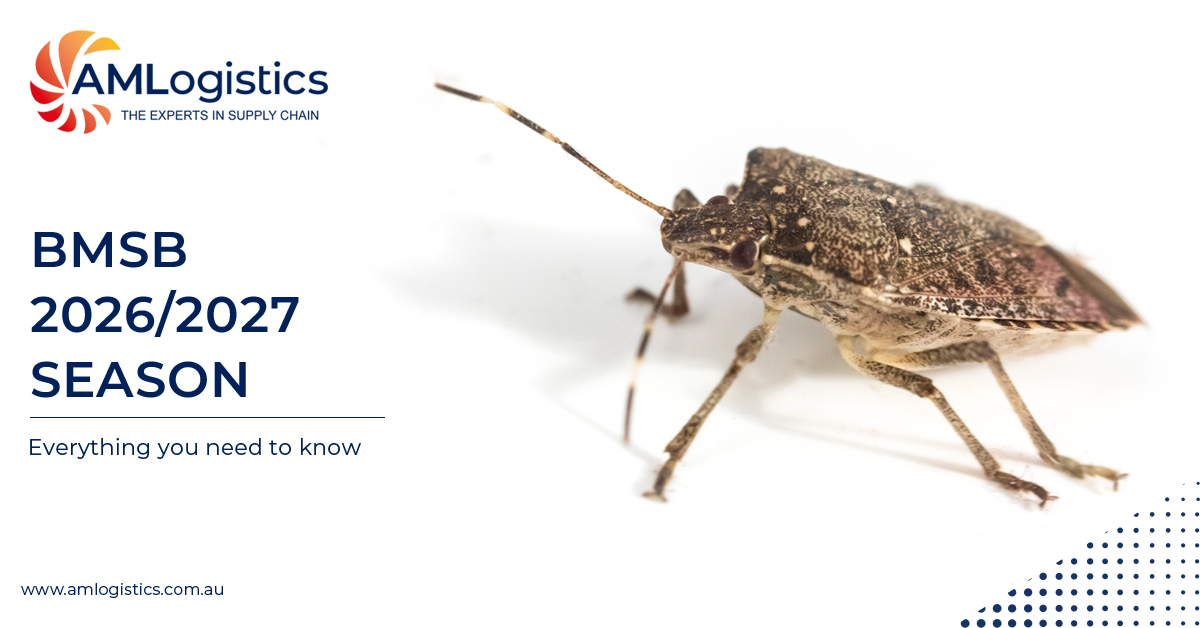
BMSB is shield shaped, mottled brown with a smooth rounded shoulder. It can grow up to 17 mm long and feeds on crops and ornamental plants. The bug produces an unpleasant odour when crushed.
Why is BMSB a concern?
BMSB poses a significant risk to Australia’s agriculture
- Damages agricultural crops, fruits, nursery stock and ornamental plants
- Feeds on over 300 plant species
- A smelly nuisance in homes and buildings
- Hitchhike on imported goods
BMSB is exotic to Australia and must be kept out. They hitchhike on imported goods, including personal items, machinery, vehicles, ships, boats and aircraft.
The bugs damage agriculture crops, nursery stock and ornamental plants. They feed on over 300 plant species, including sweet corn, tree nuts and fruits such as apricots, figs, apples, peaches and citrus.
The bugs pierce through the skin/surface of fruits and inject saliva, feeding on the juices of the fruit. This leaves dimpling on the externals, rotting and corking of the insides of the fruit. If impacted fruit is used for juice production, it could ruin the entire batch.
Who does BMSB affect?
There are seasonal measures that affect importers of targeted goods from targeted countries
- New Zealand and Australian importers of;
- Targeted goods from;
- Target risk countries and;
- Shipped via Seafreight between;
- 01 September to 30 April (inclusive)
BMSB seasonal measures affect importers of targeted goods that are manufactured in or shipped from target risk countries, and have been shipped via Seafreight between 01 September and 30 April (inclusive). BMSB measures also apply to vessels that berth, load or tranship from target risk countries within the same period.
Note: The shipped on board date, as indicated on the Ocean Bill of Lading, is the date used to determine when goods have been shipped. “Gate in” dates and times will not be accepted to determine when goods are shipped.
What are the BMSB seasonal measures?
Seasonal measures include specific treatment methodologies which are subjective to different types of sea cargo
- Target high risk goods require mandatory treatment
- Target risk goods are subject to random inspection
- Standard FCL & LCL can be treated offshore or onshore
- Breakbulk must be treated offshore only
- Heat, Methyl Bromide, Sulfuryl Fluoride and Ethyl Formate treatment only
- Specific packing requirements to be followed
Goods that are classed as target high risk require mandatory treatment. Goods that are classed as target risk are subject to random inspection. Goods that are not targeted are not subject to BMSB measures unless packed with targeted goods.
Target high risk goods must be treated by an ‘approved’ treatment provider. Treatment certificates will not be accepted from treatment providers that are unregistered, suspended, withdrawn or under review and will be rejected from entry and subject to additional mandatory treatment measures, which may or maybe offshore and of high expense.
Standard FCL and LCL consignments can be treated offshore or onshore, whereas Breakbulk must be treated offshore only.
- LCL must be treated at the container level
- Breakbulk (includes Open Top, Flat Rack and Modified Containers) will be directed for export if not treated offshore
Treatment options currently include Heat Treatment, Methyl Bromide Fumigation, Sulfuryl Fluoride and Ethyl Formate Fumigation.
Treated consignments maybe subject to random verification inspections.
There are specific packing requirements that allow treatments to work effectively. Consignments that are not packed to the required standard will be directed to a 4.7 depot for a complete unpack and fumigation, which may require to perforate packaging.
Who are the target risk countries?
There are many countries that have been identified as Target Risk
- There is a list of Target Risk Countries that are subject to BMSB measures for targeted goods
- This list is subject to change and continuous review
Target Risk Countries currently include Albania – Andorra – Armenia – Austria – Azerbaijan – Belgium – Bosnia and Herzegovina – Bulgaria – Canada – China (heightened vessel surveillance only) – Croatia – Czechia – France – Japan (heightened vessel surveillance only) – Georgia – Germany – Greece – Hungary – Italy – Kazakhstan – Republic of Korea (heightened vessel surveillance only) – Kosovo – Liechtenstein – Luxembourg – Montenegro – Moldova – Netherlands – Poland – Portugal – Republic of North Macedonia – Romania – Russia – Serbia – Slovakia – Slovenia – Spain – Switzerland – Türkiye – Ukraine – United States of America – Uzbekistan
What are the emerging risks and who are the countries?
There are several countries that have been identified as Emerging Risk
- There is a list of Emerging Risk Countries that may be selected for random onshore inspection
- This list is subject to change and continuous review
Emerging Risk Countries currently include United Kingdom – China – Japan – Republic of Korea – Target High Risk goods do not require mandatory treatment, however subject to increased intervention through random inspection.
In addition to the target high risk goods, chapters 39, 94 and 95 will be subject to random inspections for emerging risk countries only.
Important Note: Airfreight consignments of target high risk goods shipped from United States of America and China between 01 September to 30 April (inclusive) will be subject to random inspections.
What are the targeted goods?
Goods that fall within the following tariff classifications have been categorised as Target High Risk Goods or Target Risk Goods
- Target High Risk Goods will require mandatory treatment for BMSB risk
- Target Risk Goods are only subject to increased onshore intervention through random inspection
Target High Risk Goods include;
44 – Wood and articles of wood; wood charcoal
45 – Cork and articles of cork
57 – Carpets and other textile floor coverings
68 – Articles of stone, plaster, cement, asbestos, mica or similar materials
69 – Ceramic products – including sub chapters I and II
70 – Glass and glass ware
72 – Iron and steel – including sub chapters I, II, III, IV
73 – Articles of iron or steel
74 – Copper and articles thereof
75 – Nickel and articles thereof
76 – Aluminium and articles thereof
78 – Lead and articles thereof
79 – Zinc and articles thereof
80 – Tin and articles thereof
81 – Other base metals; cermets; articles thereof
82 – Tools, implements, cutlery, spoons and forks, of base metal; parts thereof of base metal 83 – Miscellaneous articles of base metals
84 – Nuclear reactors, boilers, machinery and mechanical appliances; parts thereof
85 – Electrical machinery and equipment and parts thereof; sound recorders and reproducers, television image and sound recorders and reproducers, and parts and accessories of such articles
86 – Railway or tramway locomotives, rolling-stock and parts thereof; railway or tramway track fixtures and fittings and parts thereof; mechanical (including electro-mechanical) traffic signalling equipment of all kinds
87 – Vehicles other than railway or tramway rolling-stock, and parts and accessories thereof
88 – Aircraft, spacecraft, and parts thereof
89 – Ships, boats and floating structures
Target Risk Goods include;
27 – Mineral fuels, mineral oils and products of their distillation; bituminous substances; mineral waxes
28 – Inorganic chemicals; organic or inorganic compounds of precious metals, of rare-earth metals, of radioactive elements or of isotopes – including sub chapters I, II, III, IV and V
29 – Organic chemicals – including sub chapters I, II, III, IV, V, VI, VII, VIII, IX, X, XII and XIII
38 – Miscellaneous chemical products
39 – Plastics and articles thereof – including sub chapters I and II
40 – Rubber and articles thereof
48 – Paper and paperboard; articles of paper pulp, of paper or of paperboard
49 – Printed books, newspapers, pictures and other products of the printing industry; manuscripts, typescripts and plans
56 – Wadding, felt and nonwovens; special yarns; twine, cordage, ropes and cables and articles thereof
Sealing Declaration
A sealing declaration can be used to demonstrate when goods were sealed inside a container.
- A sealing declaration can be utilised for FCL containers in certain circumstances.
- Target high risk goods packed and sealed in a six hard sided container in a target risk country prior to 01 September, may be exempt from mandatory treatment with a sealing declaration.
BMSB sealing declaration can be utilised in the following circumstances:
- Goods were containerised and sealed in a container prior to 1 September, but shipped on board after this date
- The bill of lading does not state the shipped-on board date
- Target high risk goods were manufactured, packed and sealed in a container in a non-target risk country but have been shipped from a target risk country.
- Goods were sealed inside the container within 120 hours of treatment occurring offshore (for treatments conducted prior to 1 December).
Note: Sealing declarations cannot be used for open top, flat rack or modified containers.
Declaration Requirements:
Sealing declarations must be completed and signed by either the exporter, freight forwarder, or shipping company at the port of origin.
Australian based importers/brokers cannot sign off on these declarations, and they will not be accepted by the department.
New, Unused and not Field Tested (NUFT)
Goods that fall within the following tariff chapters and manufactured from 01 December may be eligible for the NUFT scheme.
- New, Unused and not Field Tested goods manufactured from 01 December and classified under certain tariff chapters may be exempt from mandatory treatment with a BMSB NUFT declaration.
The BMSB New, Unused and not Field Tested (NUFT) scheme allows for an exemption of mandatory treatment. The BMSB NUFT criteria relates to goods classified under certain tariff chapters and have a manufacture start date on or after 01 December of the current BMSB risk season.
Refurbished goods do not meet the criteria.
BMSB NUFT declaration may be used for eligible goods shipped as FCL, LCL or Break Bulk provided the goods are not packed with other untreated high risk non-eligible tariff goods.
Eligible Tariff Chapters include 82, 84, 85, 86, 87, 88, 89
Treatment Options
Treatment options currently include Heat Treatment – Methyl Bromide Fumigation – Sulfuryl Fluoride Fumigation – Ethyl Formate Fumigation
- Onshore approved providers can be found on the list of approved arrangement providers
- Offshore approved AusTreat providers can be found on the list of pre-border biosecurity treatment providers
Packing Requirements
There are specific packing requirements that allow treatments to work effectively
- Containers must be packed to allow sufficient free air space for fumigation gasses or heat treatment
- Plastic wrappings must meet the specified perforation requirements to be considered acceptable
- Detailed packing requirements can be found on the fumigation methodology document
There must be sufficient free air space throughout the container and the goods to allow the fumigant or heat treatment to freely circulate around the target of the fumigation and to permit the positioning of fans and sampling tubes or temperature sensors.
The free air space requirements for effective treatment of a consignment will vary depending on the commodity and the method of packing. As a guide, there should be at least 100mm free air space above the commodity, 100 mm below and 100 mm at the sides and between the commodities, with a maximum load factor of 80%.
Goods must be loaded inside the container with adequate space above, below, at the sides, in between and around the goods, either placed on pallets or raised off the floor, to ensure effective fumigation.
Goods must not be covered by impermeable packaging, wrapping or surface coatings to allow fumigant to penetrate and allow for effective treatment.
Plastic wrapping, if necessary, must be in a single layer and perforated with at least 4 holes of 6 mm diameter or 5 holes of 5 mm diameter for every 100 mm x 100 mm of surface area, or 6 pinholes per 10 mm x 10 mm surface area to be considered pervious and acceptable.
If the target of fumigation is timber, it must have one physical dimension 200mm thick in one direction. It must be stacked and separated by a minimum of 5 mm of airspace every 200 mm. The separation can be horizontal or vertical.
Post Treatment Window
A 120 hour post treatment window applies to goods treated prior to 01 December of the current BMSB season
- The post treatment window requires goods to be sealed or loaded onto a vessel within 120 hours of treatment
- Goods treated in a target risk country prior to 01 December are subject to a 120 hour post treatment window
- Goods that have not met the post treatment window may need to be retreated onshore or directed for export
Containerised Goods
- Goods must be loaded into a six hard sided container and sealed within 120 hours.
- A sealing declaration can be provided if required.
→ Onshore treatment permitted for target high risk goods in sealed-six hard sided containers.
→ If the goods cannot be treated at a container level, or if the importer refuse treatment of the goods, the cargo will be directed for export
Break bulk (including flat racks and open top containers) and modified containers
- Must be loaded onto a vessel for export from the target risk country within 120 hours.
- The shipped on board date, as indicated on the Ocean Bill of Lading, is the date used to determine when goods were loaded on the vessel.
→ Will be denied discharge and / or immediately directed for export.
→ Exceptions apply under the BMSB Rolled Goods Policy.
Note: The post treatment window does NOT apply to goods treated in a non-target risk country, or to goods treated from 01 December (inclusive) of the current BMSB season
Transhipped Goods
Transhipped goods through a target risk country may be subject to BMSB seasonal measures.
- Transhipped goods are goods discharged in a target risk country for onforwarding to another country.
- Target high risk goods shipped as breakbulk and transhipped through a target risk country between 01 September and 01 December (inclusive) are subject to a 120 hour transhipping window.
Mandatory BMSB treatment is required where all the following circumstances apply
- Goods are transhipped between 01 September and 01 December (inclusive),
- Goods are being transhipped via a target risk country,
- Goods are categorised as target high risk goods,
- Goods are being shipped as break bulk/flat rack/open top or in a modified container, and
- Goods spend more than 120 hours in the target risk country
Note: Containerised goods sealed in a non-target risk country and not opened during transshipment through a target risk country are not subject to BMSB seasonal measures. A sealing declaration will be accepted.
In-transit Policy
The in-transit policy applies when an offshore treatment provider status changes during shipment
- Goods are classified as in-transit when they have left the origin country but have not been cleared at the Australian border
- BMSB treatment certificates from under-review or suspended offshore treatment providers are deemed unacceptable under the in-transit policy
- Goods may be eligible for discharge/unloading on arrival and onshore retreatment with an approved in-transit application
Break bulk goods (including open top or flat rack containers) shipped on or before, or within 120 hours after, the treatment provider was placed under review or suspended
- May be permitted for discharge/unload on arrival and onshore treatment within 48 hours of arrival, with an approved in-transit application.
- In-transit application must be submitted and accepted by the department prior to goods arrival in Australia .
Break bulk goods (including open top or flat rack containers) shipped after the treatment provider was placed under review or suspended
- Not permitted to be discharged/unloaded in Australia.
- If already unloaded, will be immediately contained and directed for export.
Break bulk goods (including open top or flat rack containers) that arrived or were discharged before or on the date the treatment provider was placed under review or suspended
- May be permitted for onshore treatment within 48 hours of arrival, with an approved risk management plan.
- Goods may be subject to further inspection.
Goods shipped as containerised cargo in sealed-six hard sided containers and treated by an offshore provider under review or suspended
- Permitted to discharge/unload on arrival under current procedures.
- Must undergo onshore treatment by a department approved provider.
- Deconsolidation or segregation of goods will not be permitted before treatment.
- Goods may be subject to further inspection.
More information
If you would like to organise a time to speak with us and discuss these measures in more detail or prepare a BMSB Seasonal Plan, please contact AM Logistics.
- Download a copy of the latest BMSB Seasonal Measures here
- Contact AM Logistics here